
Shopify Partner Program Overview: How to Become Shopify Partner in 2026
If you want to learn how to become a Shopify Partner in 2026, this guide will give you everything you need. The Shopify Partner Program allows you to offer services, create apps, support merchants, and earn rewards based on the value you provide.
This guide will walk you through:
- The basics of the Shopify Partner Program
- Step-by-step instructions to join the program
- Major benefits you get after becoming a partner
- Tips to succeed based on real experience from LitOS
Now, let’s explore how the program works and why it’s a strong opportunity this year.
What is the Shopify Partner Program
The Shopify Partner Program gives freelancers, agencies, and technology teams a structured way to work with Shopify and support merchants across many stages of growth. It offers tools, training, and earning opportunities that help partners build stronger services and create real impact for the businesses they work with.
What is a Shopify Partner?
A Shopify Partner is an individual or business that helps merchants get more value from the Shopify platform. Partners can build stores, improve performance, design themes, create apps, or provide ongoing support. Anyone with skills in design, development, marketing, or ecommerce operations can join and start contributing to the Shopify ecosystem.
What does a Shopify Partner do?
A Shopify Partner supports merchants at every stage of their journey. You can help a new store get set up, assist an active store that wants to improve performance, or guide a growing store that is ready for advanced solutions. Many partners also create apps or integrations that solve specific business needs.
How do Shopify Partners earn money?
Shopify Partners earn money in several ways. You can create development stores and transfer them to clients, refer merchants to Shopify plans, or provide launch support for new stores. Developers can earn revenue through the Shopify App Store or Shopify Theme Store.
| Earning method | How it works | Revenue kept by partner |
| Shopify App Store | Partners create public apps and sell them through app subscriptions, usage based fees, or one time purchases. | Keep 100 percent of the first 1 million USD in annual app revenue. After that, keep 85%. |
| Enterprise Solutions | Partners build advanced integrations or custom solutions for large merchants, often sold through the App Store or direct licensing agreements. | Revenue varies based on the contract or license terms. |
| Shopify Theme Store | Partners design premium Shopify themes and sell them as a one-time purchase in the Theme Store. | Keep 85% of all theme sales. |
As of 2025, service partners also earn revenue share from recurring subscription fees and variable platform fees. This means your earnings increase as your clients grow.
How to Become a Shopify Partner
You only need a Shopify account, basic business information, and a clear idea of the services or solutions you want to provide. Follow the steps below to set up your partner account and begin your journey inside the Shopify ecosystem.
Step 1. Visit the Shopify Partner page and choose how you want to join
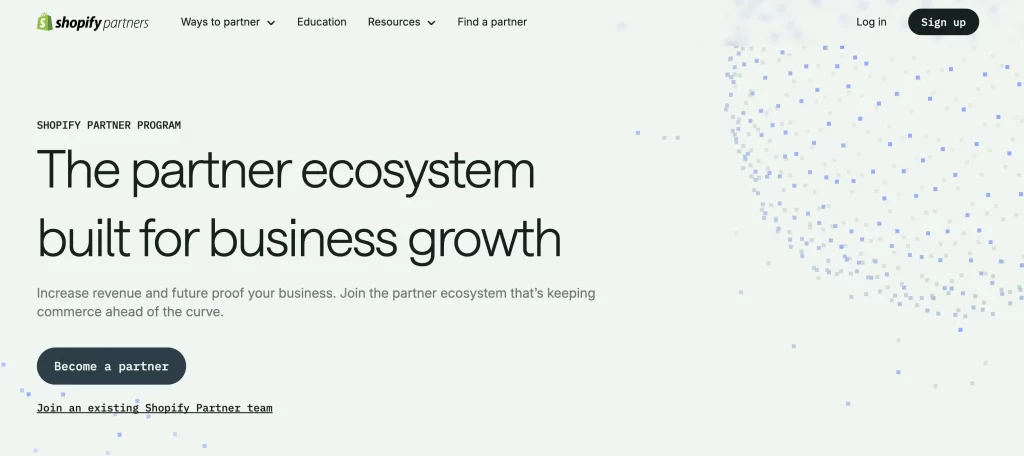
To start, visit the Shopify Partners website and click the Join now button.
When you begin the signup process, Shopify will ask how you want to join the program. You can choose one of two paths.
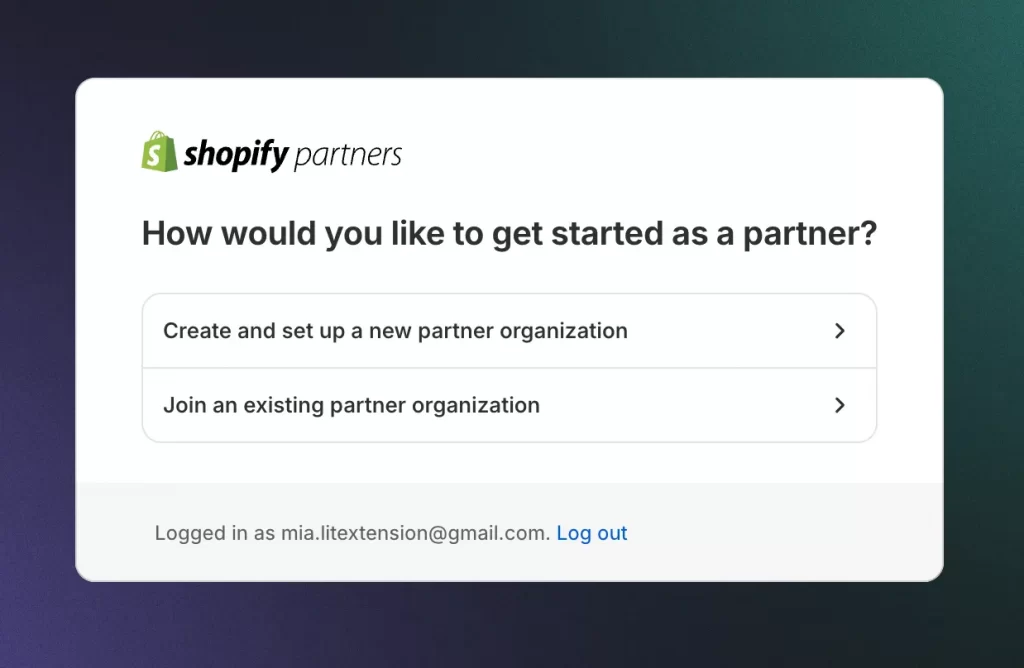
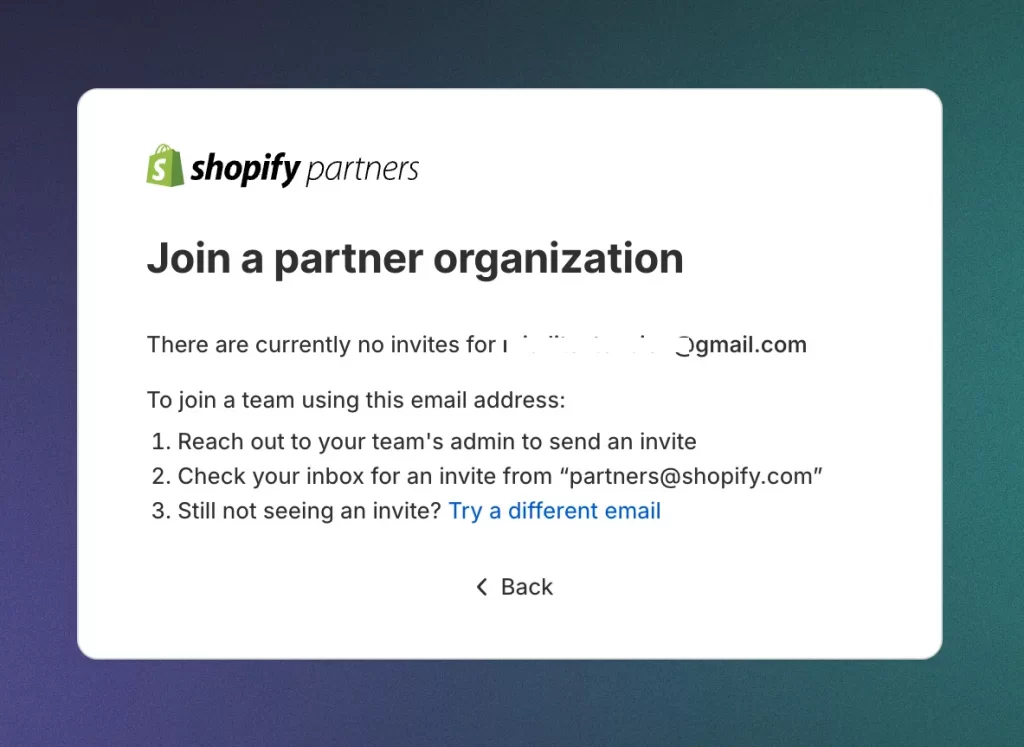
1. Join an existing partner organization
Select this option if your company already has a partner team. Shopify will ask for the email your team’s admin has invited. If there are no invites, contact your admin and request an invitation. When the invite arrives, open the email from [email protected] and accept it.
2. Create and set up a new partner organization
Choose this option if you are starting your own partner account.
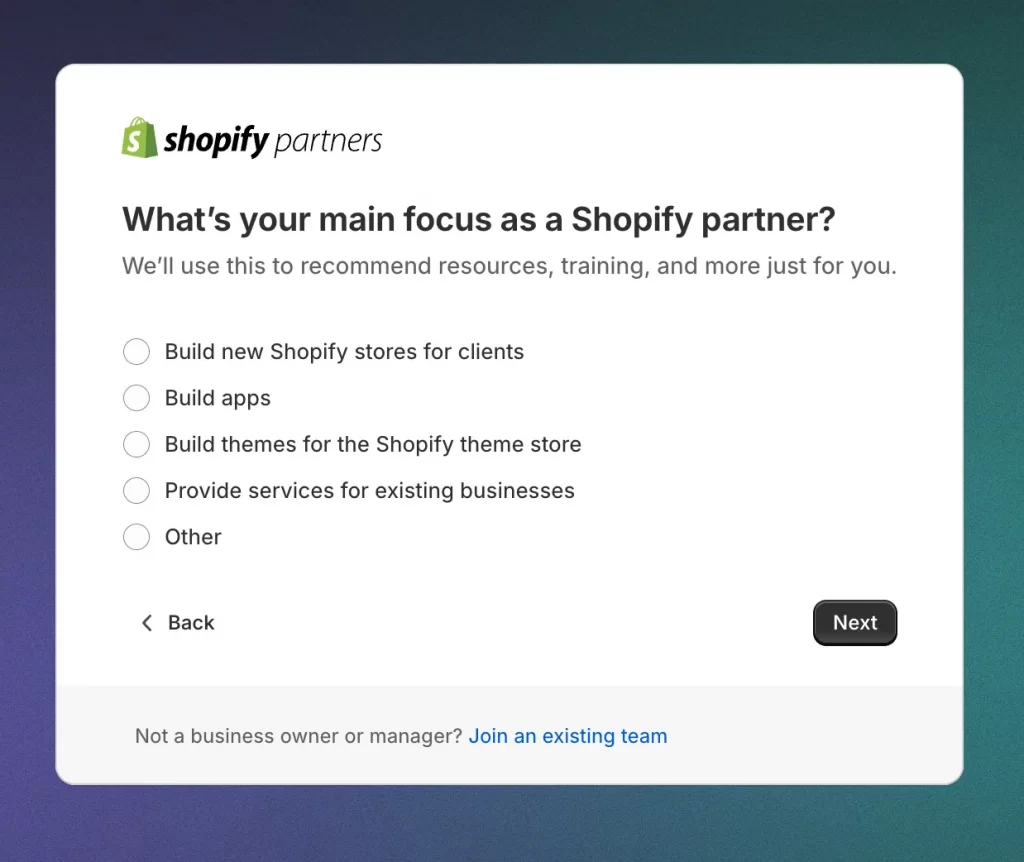
After selecting it, Shopify will ask about your main focus as a partner. You can choose to build stores for clients, build apps, design themes, or provide services for existing businesses. This helps Shopify recommend the right resources and tools for your work. After selecting your focus, click Next to continue with the setup.
Step 2. Create your account and complete the first setup questions
If you are creating a new partner organization, Shopify will guide you through a few quick questions to set up your account. After selecting your main focus as a partner, the next screen will ask for your business location.
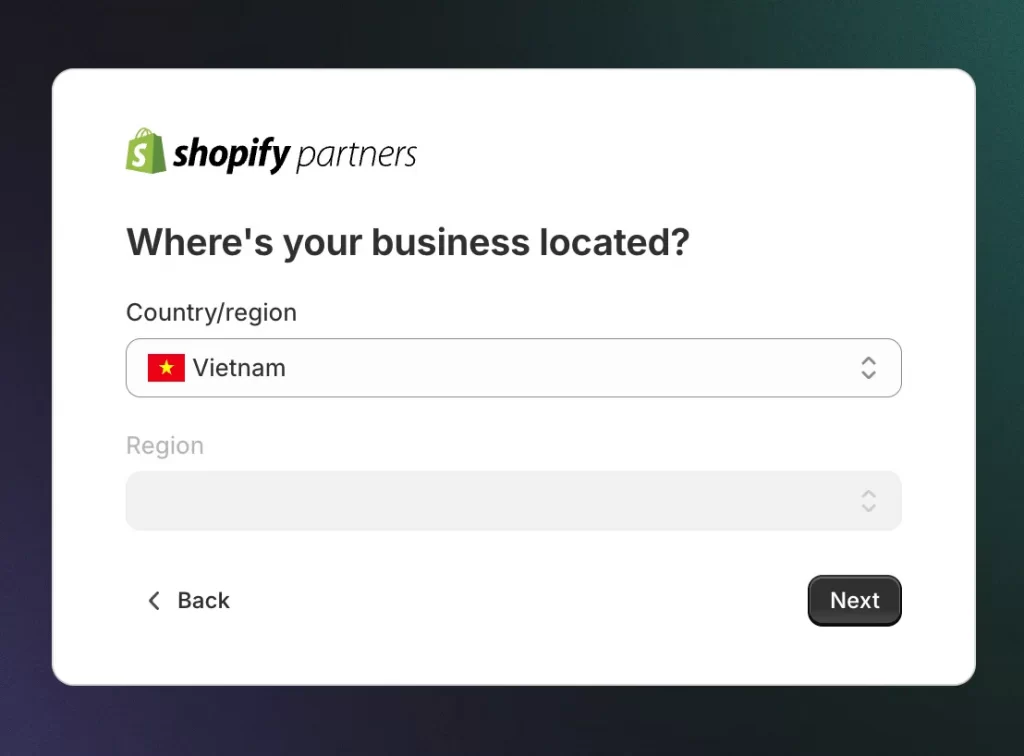
Choose your country or region, then continue to the next step. Shopify uses this information to recommend the right resources and to set up your account correctly.
Step 3. Complete your partner profile
Next, Shopify will ask for your business details to create your partner organization. Fill in your business name, job title, address, city, and postal code.
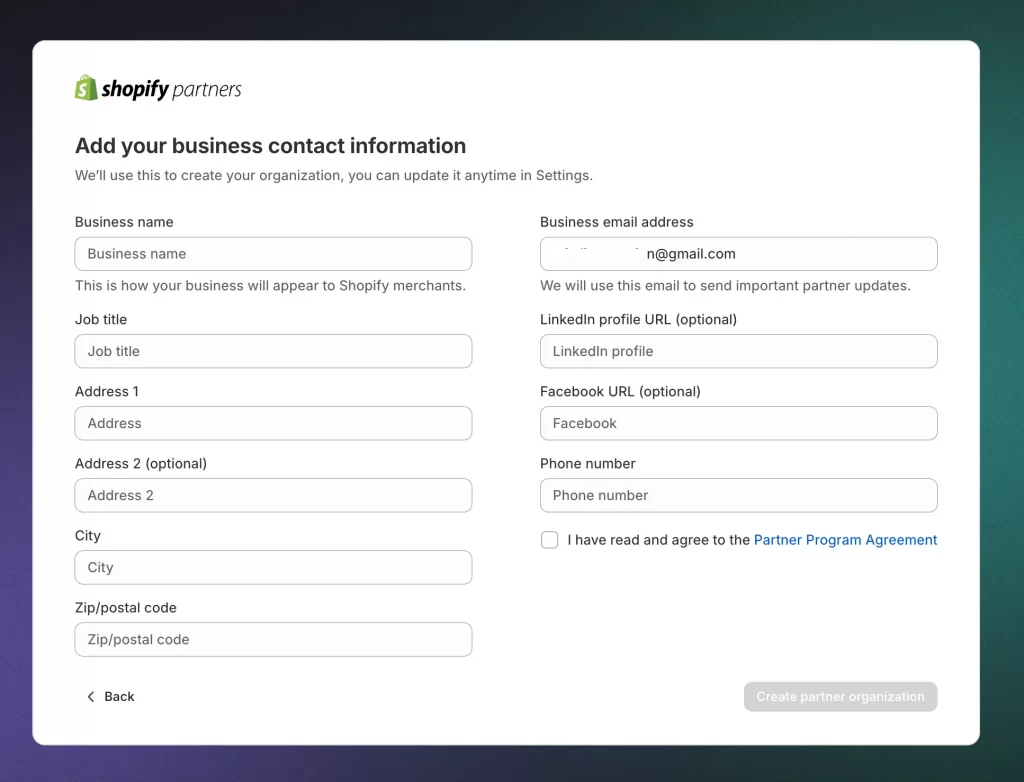
You will also confirm your business email and can add optional links such as LinkedIn or Facebook. Enter your phone number, agree to the Partner Program Agreement, and then continue. These details help Shopify set up your account and help merchants understand who you are.
Step 4. Explore your Shopify partner directory
Your Shopify Partner dashboard gives you access to tools, resources, and development environments. You can create a development store, browse Shopify Partner Academy courses, or explore app and theme documentation.
Step 5. Start building your first Shopify project
Create your first development store or begin working on an app, theme, or integration. This is the best way to practice, understand the workflow, and prepare for real client projects. Each project you complete helps build your portfolio and improve your credibility as a new partner.
Key Benefits of Joining Shopify Partner Program
Joining the Shopify Partner Program gives you access to a strong set of tools and opportunities that help you grow your skills, build your client base, and increase your income. These benefits support both new partners and experienced teams that want to expand their Shopify expertise.
1. Access to education and Shopify Partner Academy
You can learn directly from Shopify through detailed training courses, certifications, and best practice guides. Partner Academy covers topics such as store setup, theme development, app development, performance optimization, and ecommerce strategy. These resources help you improve your skills and deliver better results for clients.
2. New revenue opportunities
Partners can earn money through development stores, merchant referrals, launch support, app sales, theme sales, or revenue share on subscription and platform fees. The program rewards you for the real value you bring to merchants, and your income can grow as your clients succeed.
3. Tools, sandboxes, and resources
Your Shopify Partner dashboard provides access to development stores, preview environments, documentation, private apps, and testing tools. These resources allow you to explore new features, experiment with ideas, and build client projects without risk or extra cost.
4. Increased credibility and visibility
Being a Shopify Partner strengthens your reputation and helps you stand out to merchants who want experienced support. A complete profile, case studies, and positive reviews can help you attract more clients. Many partners also earn visibility through the Partner Directory or through features in Shopify community channels.
Practical Tips to Succeed as a Shopify Partner
These practical tips help you grow faster inside the Shopify ecosystem and build a strong reputation as a partner. You can use them to improve your skills, attract more clients, and reach higher partner tiers over time.
1. Choose the right partner track (Service vs Technology)
Shopify offers two main directions.
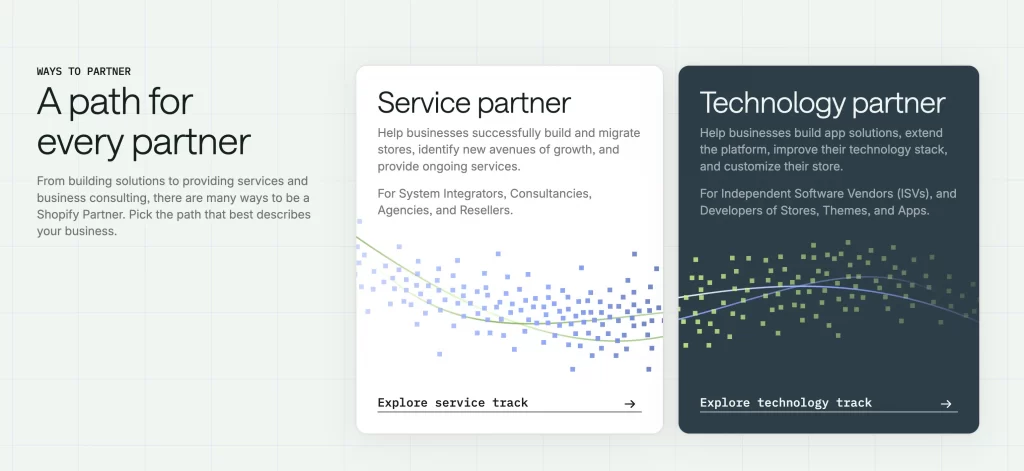
Service Partners focus on store builds, migrations, branding, performance work, and ongoing support. Technology Partners focus on apps, integrations, and advanced solutions for merchants.
| Category | Service Partner Track | Technology Partner Track |
| Best for | Freelancers, developers, designers, and agencies that work directly with merchants | Software teams, engineers, and product companies that build apps or integrations |
| Primary focus | Store builds, migrations, redesigns, optimization, branding, marketing, long term support | App development, integrations, enterprise solutions, and theme development |
| Type of work | Project based work with direct client communication | Product based work with scalable solutions |
| How income grows | More clients, larger projects, ongoing retainers, migration work | More app users, theme sales, enterprise licenses, recurring subscriptions |
| Ideal skill set | Design, development, ecommerce setup, CRO, marketing, consulting | Engineering, backend development, API mastery, product design |
| Merchant interaction | High. You work closely with each client throughout the project | Low to medium. You support users but do not manage full store builds |
| Scalability | Linear growth based on service capacity | High scalability because one app can serve many stores |
| Examples | Store migration to Shopify, theme customization, brand setup, page speed improvement | Inventory app, ERP integration, marketing automation tool, premium theme |
The more you align your strengths and business direction with the right partner track, the more room you gain to grow, improve, and succeed within Shopify’s ecosystem.
2. Build a strong service portfolio
A clear list of services helps merchants understand how you can support their business. Include store setup, redesigns, migrations, performance optimization, marketing, or custom development. Match your offers to your strengths so clients know exactly what you do best.
3. Specialize in a niche such as migration, headless, or CRO
A clear niche helps you stand out inside the Shopify ecosystem. You can focus on areas such as Shopify migrations, headless builds, conversion optimization, retention, or custom integrations. A defined specialty makes it easier for merchants to understand your strength and choose you for higher quality projects.
4. Add case studies and measurable results
Merchants trust partners who show real outcomes. Highlight the problem, your approach, and the results you delivered. Metrics such as page speed improvement, higher sales, or better conversion rates help you build credibility and win more clients.
5. Network with the Shopify ecosystem
Join the Shopify Community, attend events, follow Shopify product updates, and connect with other partners. Strong relationships help you stay informed, learn faster, and discover new opportunities for collaboration or referrals.
6. Apply for higher partner tiers when eligible
As your experience grows, you can aim for higher tiers in the partner program. Higher tiers provide more benefits such as priority support, co-marketing programs, and stronger placement in the Partner Directory. This can increase your visibility and help you attract larger clients.
Honest Sharing: A LitOS Partner Success Story
We, the LitOS – Shopify Select Partner team, want to share our experience with anyone who is starting their journey as a Shopify Partner. When we first joined the ecosystem, we had many of the same questions new partners have today.
How do we get our first clients? How do we build trust? How do we deliver good work consistently?
Over time, we learned that progress comes from steady work, honest communication, and keeping things simple for merchants.
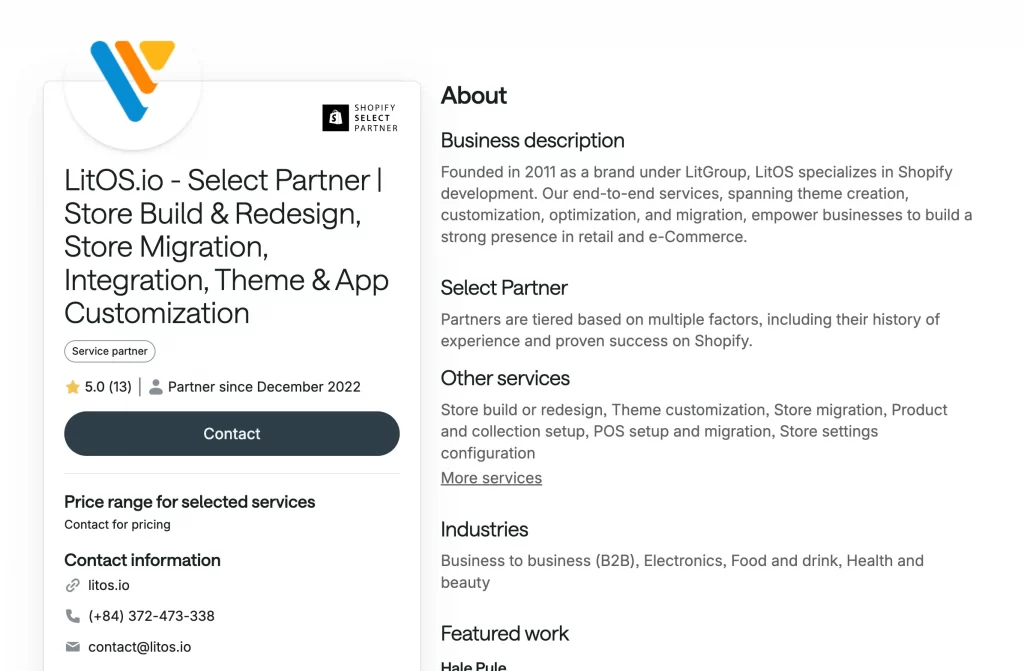
In the early days, we focused a lot on migrations and redesigns. These projects taught us that most merchants are not just looking for technical skills. They want clarity, patience, and a team that can guide them without making the process feel heavy. This mindset became the core of how we work today.
What helped us grow as a partner
1. Staying close to merchants
Listening carefully to what merchants need helped us make better decisions. Many clients shared challenges about their old platforms, such as slow performance or confusing interfaces. Understanding these issues helped us improve the way we build Shopify stores.
2. Improving step by step
We did not try to become experts overnight. We learned through each project, each mistake, and each conversation. Every time we finished a store, we looked at what went well and what we could do better next time.
3. Keeping communication simple
Many merchants tell us they appreciate how we explain things clearly. We avoid complicated terms and focus on clarity. This single habit helped us build long term trust more than anything else.
4. Taking pride in small wins
A smoother checkout, a cleaner product page, a faster load time. These small improvements often matter more to merchants than big changes. Focusing on these details strengthened our work and built confidence over time.
What we want new partners to know
If you are early in your Shopify Partner journey, here are a few things we learned along the way:
- You do not need to know everything on day one
- Clients value reliability more than perfection
- Honest communication builds trust faster than fancy language
- Your skills will grow through real projects, not theory alone
- The Shopify ecosystem rewards consistency and care
Our commitment moving forward
We are still learning. We are still improving. And like every partner, we are growing through each project we complete. What keeps LitOS motivated is knowing that every store we build makes someone’s business easier to run.
If you are just beginning as a Shopify Partner, we hope our experience helps you feel a little more confident as you start your own path. The journey takes time, but it is worth it.
How to Become a Shopify Partner: FAQs
Is being a Shopify Partner worth it?
Yes. Being a Shopify Partner is valuable if you want to grow your skills, attract more clients, and access a stable ecosystem with strong long term demand. You gain tools, training, and earning opportunities that support you through both small and large projects.
How much does it cost to become a Shopify Partner?
Joining the Shopify Partner Program is free. You only need a Shopify account and basic business information to get started. You can explore tools, create development stores, and access Partner Academy without paying any fees.
How much do Shopify partners make?
Shopify partners can earn through apps, enterprise solutions, and themes. App developers keep 100% of the first 1M USD in annual revenue and 85% beyond that, while theme creators keep 85% of all sales. Earnings from enterprise solutions vary because they depend on individual contracts or licensing terms. Actual income ranges widely based on product quality, demand, pricing, and the scale of merchant adoption.
How to become a Shopify certified partner?
Shopify does not require a formal certification to join the Partner Program. You can improve your credibility by completing courses in Shopify Partner Academy. These courses help you build skills in store setup, development, theme work, app creation, and eCommerce strategy.
Final Words
If you are exploring how to become a Shopify Partner, this is a good moment to make your move. The program gives you room to learn, try new ideas, and support merchants in a practical way.
Each project helps you grow, each client teaches you something new, and each improvement builds your confidence. With steady effort, you can create a meaningful place for yourself in the Shopify ecosystem.

