
How to Write a High-Converting Shopify Product Description
If your Shopify product description isn’t doing the work, your product page probably isn’t converting.
A great description doesn’t just list features but shows value, speaks to your customer, and guides them toward checkout. But too often, merchants either write something generic, overcomplicated, or forget the customer entirely.
Here’s what you’ll get in this guide:
- A breakdown of what makes a product description work (and what doesn’t)
- Templates you can copy and customize for your own products
- Common mistakes to avoid if you want to convert more visitors into customers
Let’s start with the basics and build from there.
Note: If you haven’t added the product to your store yet, follow our step-by-step guide to add products to Shopify so your copy can go live.
What Is a Shopify Product Description?
A Shopify product description is the written content on your product page that explains what your product is, why it matters, and why someone should buy it. It lives right below your product images and title, and it plays a huge role in both the customer decision-making process and your store’s search visibility.
More than just a list of specs, a good product description answers real customer questions:
- What does this product do?
- Who is it for?
- Why should I choose this one over others?
So what makes a good Shopify product description?
- It’s written for your ideal customer, not for a generic audience or a search engine.
- It focuses on benefits (what the product helps them do or feel), not just features.
- It sounds like your brand. Casual or formal, witty or technical, since consistency matters.
- It’s easy to read, with clean formatting, scannable sections, and no walls of text.
- It builds trust through social proof, clear use cases, and confident but honest claims.
What would you say to someone if you had 30 seconds to convince them this product is right for them? That’s the version you want to bring to your Shopify store.
Pro Tip: If your product is digital instead of physical, see our guide on selling digital products on Shopify to adapt your description and delivery details.
How to Write Product Descriptions that Sell on Shopify
The best Shopify product descriptions don’t try to impress but aim to convert. They’re clear, focused, and tailored to what your customer actually wants to know.
Here’s how to get yours there:
1. Know your target customer and how they shop
Every strong product description starts with clarity about who you’re writing for.
Your customer isn’t “anyone who browses your site.” It’s someone with specific habits, expectations, and decision triggers. Are they shopping on mobile during their commute? Are they loyal to clean beauty or only buy if it’s cruelty-free? Do they compare ingredients like it’s a checklist (hello, mascara buyers) or scroll fast to find what’s smudge-resistant and easy to remove?
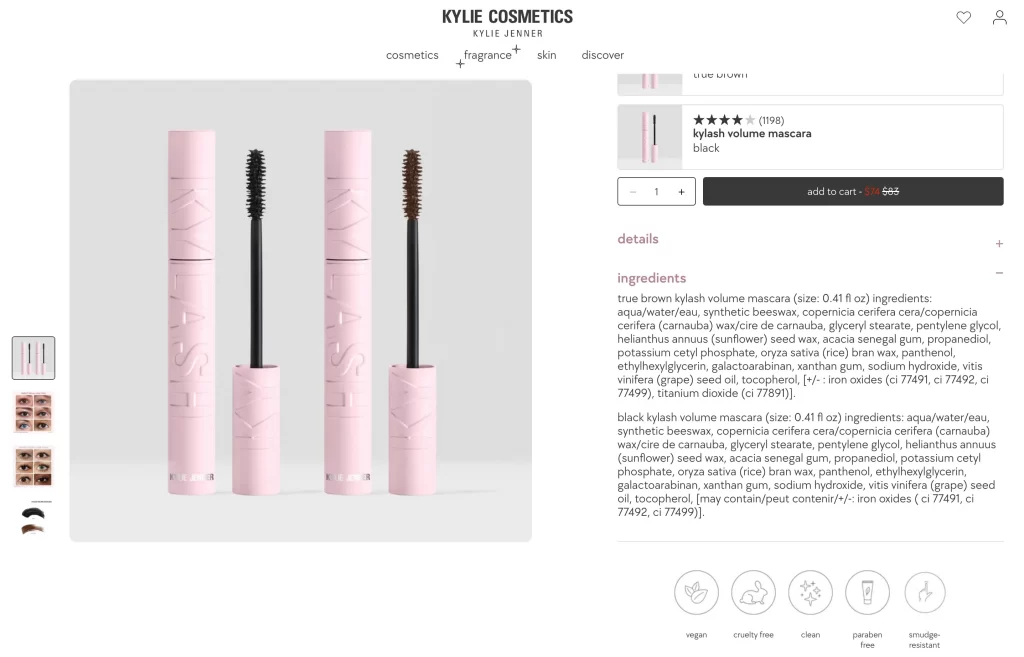
When you understand how they shop and what matters to them, you can write in a tone that resonates and include details that truly matter. For example:
- A clean beauty shopper wants reassurance: vegan, paraben-free, cruelty-free, clearly called out.
- A makeup minimalist might care more about ease: one swipe, long wear, no clumps.
- A trend follower is hunting for the “TikTok-viral” hook or real-life review images.
You’re not just writing about the product. You’re writing for the person buying it.
2. Emphasize product benefits instead of listing features
Features describe what a product is. Benefits explain why it matters.
It’s easy to fall into the trap of listing specs like materials, dimensions, tech details, but what customers really want to know is: “What does this do for me?”
Instead of: 100% waterproof nylon
Let’s try: Lightweight, waterproof nylon to keep you dry without weighing you down.
Instead of: 10-hour battery life
Let’s try: Stays powered all day, so you can work, travel, or stream without needing to reach for a charger.
You can see this approach in action on Shopify store Spigen, which sells tech accessories like the Magslide™ Phone Stand. Their copy reads:
“Look out for yourself. Unfold a better viewing experience with the Magslide™ Phone Stand. Its compact, adjustable design slides into action for the best view on any mobile device. No matter where you are, experience leisure at your fingertips.”
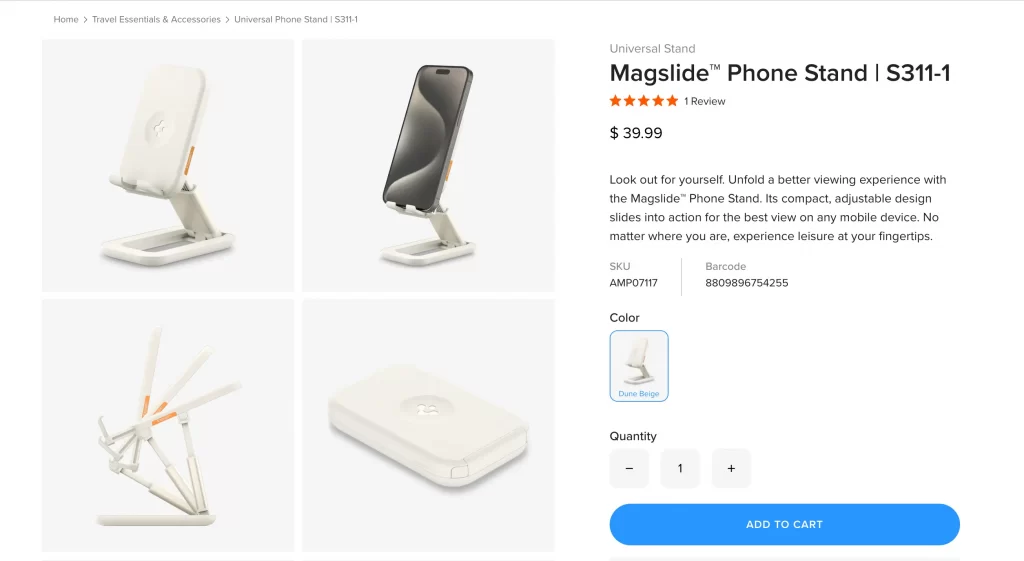
This isn’t just about angles or materials but about comfort, convenience, and use-anywhere versatility. It turns the product into a personal upgrade, not just a phone stand.
The key here is to demonstrate how your product enables your customer to do something better, faster, easier, or with greater joy. That’s what drives conversions.
Pro Tip: If you sell bundles, use benefit-driven copy that explains combined value; learn bundle strategies in our Shopify product bundles guide.
3. Use vivid, relatable language and storytelling
Flat descriptions make products forgettable. To stand out, you need language that helps customers see, feel, or imagine the product in use.
That doesn’t mean exaggerating. It means being intentional with how you describe everyday value.
Let’s compare this: “Soft cotton T-shirt available in multiple sizes.”
With this: “Your go-to weekend tee: soft, breathable, and broken-in from the first wear.”
Here is a great example from Cloudwater Brew – a store on Shopify with product Cloudwater’s rain jacket description starts with:
“WHEN YOU HAIL FROM A CITY LIKE MANCHESTER, YOU SEE THE VALUE IN HAVING SOMETHING TO KEEP YOU DRY!”
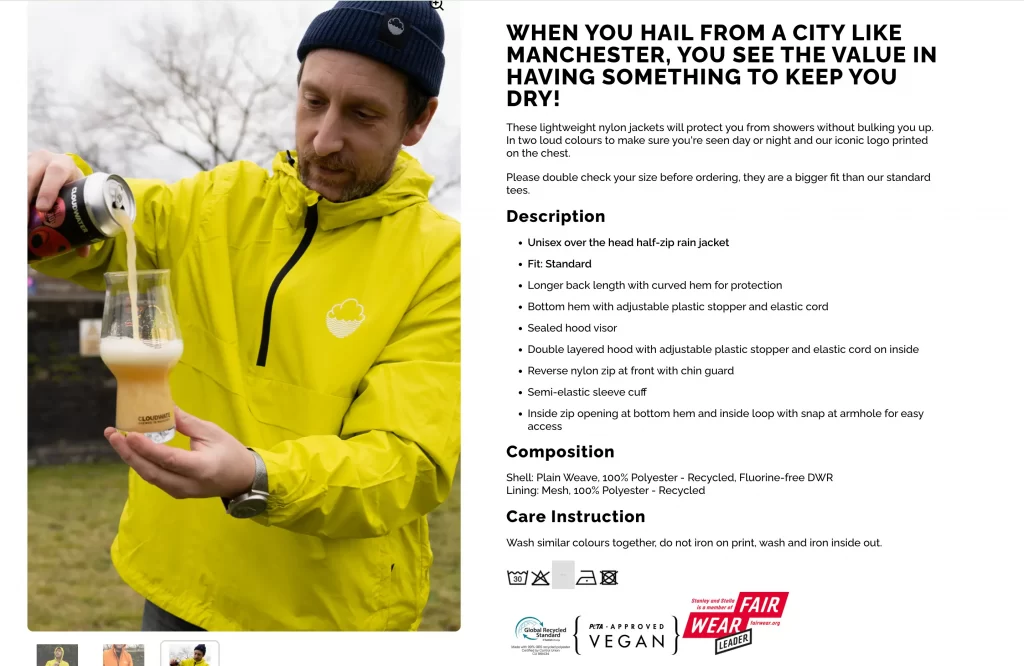
Right away, it’s human. It grounds the product in a lived experience with rainy days, local pride, and function without fuss.
And what’s the takeaway? Even a simple product becomes memorable when it’s anchored in something real.
If there’s a quick backstory (how it was made, why it exists, how customers use it), include it. You don’t need a novel, just a sentence or two can make the difference.
Pro Tip: For apparel, include a clear size guide; Here’s how to add a size chart in Shopify so shoppers choose the right fit.
4. Structure your content for quick and easy reading
Even the best copy won’t convert if it’s a wall of text.
Online shoppers scan. They’re looking for quick answers so your product description should make that as easy as possible:
- Short paragraphs (2–3 lines max)
- Clear headings or labels (like Materials, Care, or Why You’ll Love It)
- Bullet points for specs, ingredients, or features
- Bold or italics to highlight key value props
PDPaola’s product pages are a great example. For a single earring, they use a concise product name and value-focused intro (“Single hoop with a small grey gemstone drop pendant”). Additionally, there is the use of Bullet points for material, finish, and stone information.
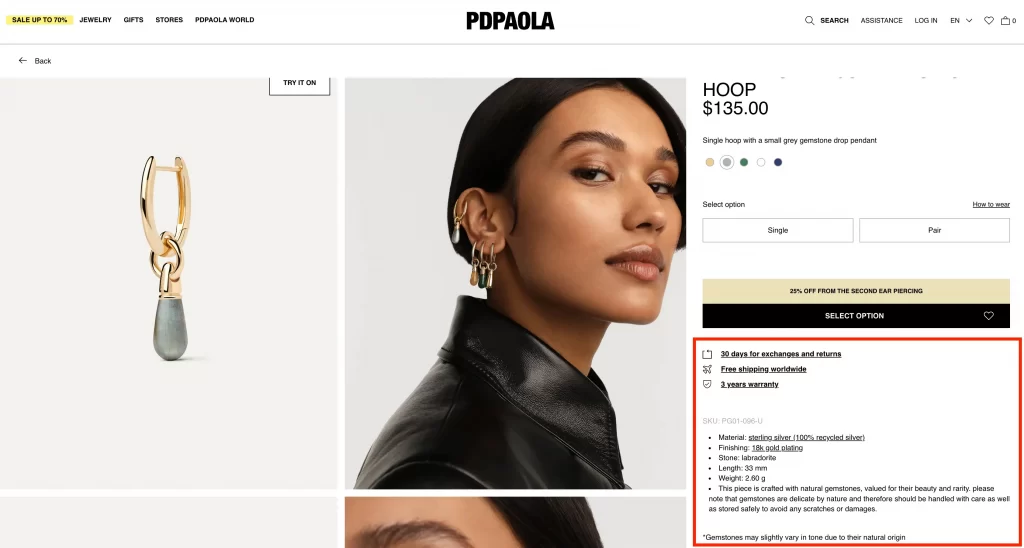
It’s clean, skimmable, and helps the shopper focus on what matters without distraction.
If you’re selling on mobile (which most Shopify stores are), this structure makes a huge difference in engagement and scroll depth.
Here is our formula: Clean formatting = faster understanding = better conversions.
5. Build trust with social proof and credibility
When people aren’t sure whether to buy, they look for signals that others have already used.
A well-placed quote from a real customer, a stat like “1,000+ five-star reviews,” or even a casual mention like “as featured in” can instantly increase trust without adding clutter.
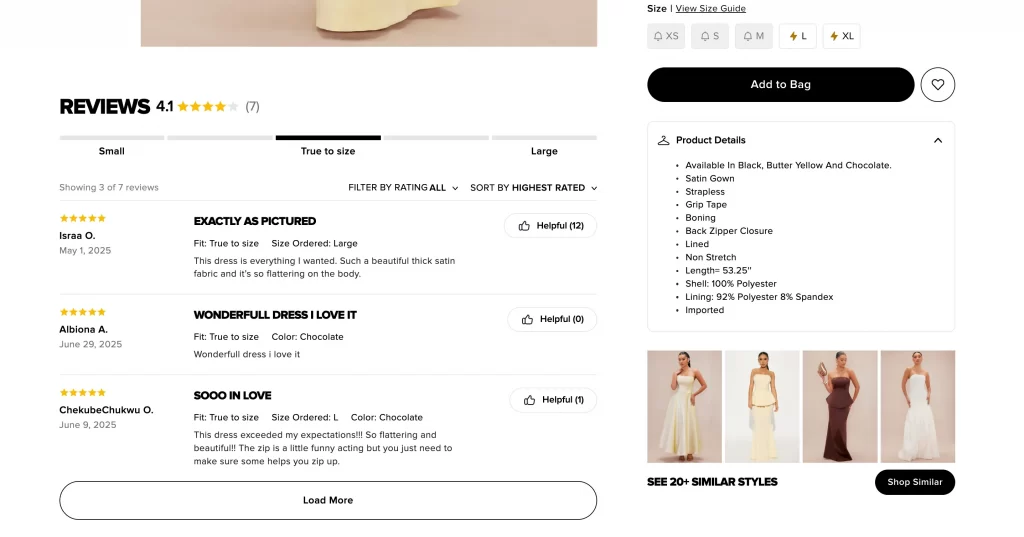
You don’t need a full review section in your description, but you can reinforce confidence with a quick proof point that says: this product delivers, and others like it are already happy with it.
The strongest trust signals come from specifics, not superlatives, and from a tone that speaks like a real person, not a pitch.
6. Speed up your workflow with AI tools like Shopify Magic and Sidekick
Actually, you don’t need to write every product description from scratch. Shopify is keeping pace with the AI boom and doing it well.
Shopify Magic product descriptions are generated using built-in AI that adapts to your tone and product type. It’s ideal for high-volume catalogs or when you’re stuck staring at a blank screen. For many merchants, Shopify Magic acts as a free product description generator, built right into the admin with no extra app required.
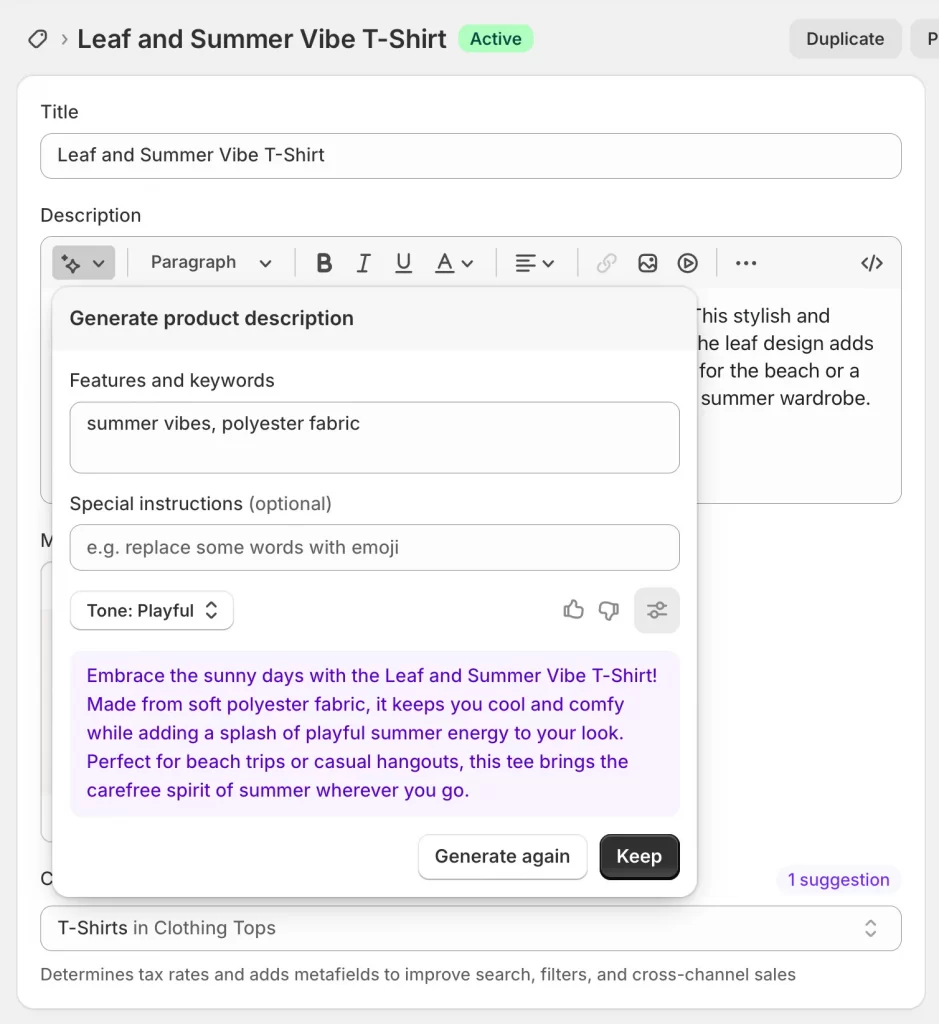
Sidekick goes even further. It understands your store context and can suggest improvements, surface missing details, or even guide you through writing better descriptions. It’s less of a tool and more of an assistant that helps you move faster without losing your voice.
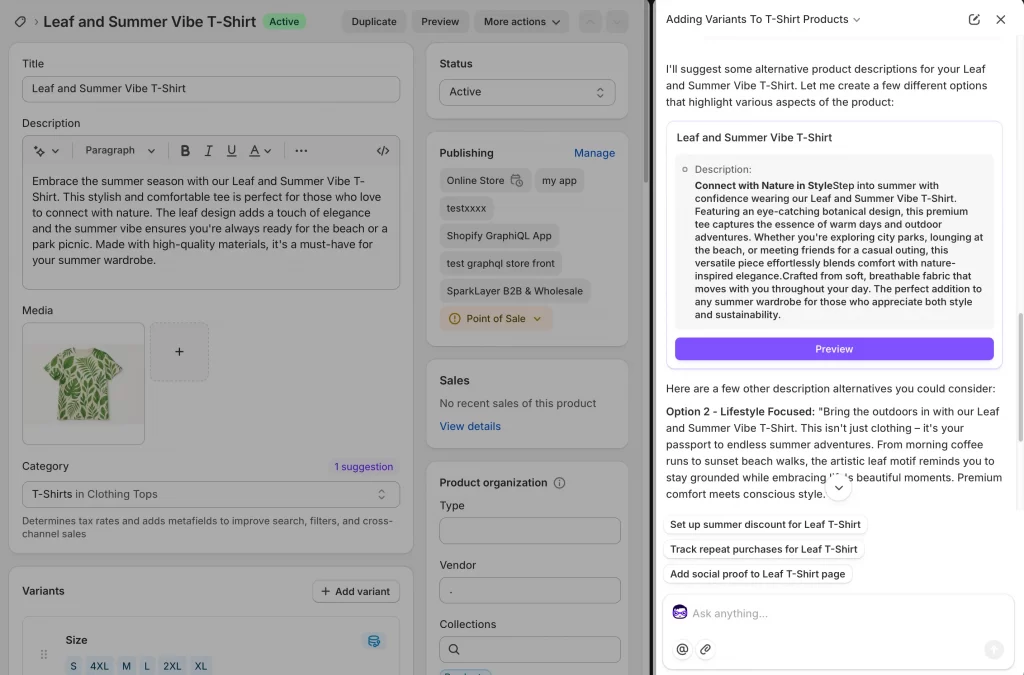
These tools won’t replace you, and they’re not supposed to.
The product is still yours. The voice is still yours. But with AI handling the heavy lifting, you can focus on refining the message and making it feel truly on-brand.
💡 LitOS tip: Many stores enhance their product pages with tabs, accordions, or collapsible sections, which are great for organizing info like care instructions or shipping. Just remember: these extras don’t replace your actual Shopify product description (product.description in Liquid). That field is still what search engines read and what builds first impressions.
At LitOS, we help brands combine strong product copy with layouts that scale beautifully. Need help? Let’s build it together →
Free Shopify Product Description Templates (Copy & Customize)
From what we’ve seen helping merchants launch and scale on Shopify, writing product descriptions tends to be where people get stuck.
Even with tools like Shopify Magic or Sidekick in the mix, it still helps to have a few solid structures you can lean on, especially when you’re short on time or managing a large catalog.
The templates below aren’t one-size-fits-all, but they’re built on patterns we know convert. We’ve pulled these formats from some of the best Shopify product description examples we’ve seen across high-performing stores. You can use them to speed up your workflow, clarify your messaging, and keep your product pages on track.
1. Template for fashion
Writing for fashion and accessories is all about balance: provide the customer with enough detail to feel confident in their purchase, but keep the tone light, clear, and easy to scan, especially on mobile devices.
Even if you’re using AI to assist with descriptions, having a base structure like this saves time and ensures your messaging remains consistent.
Here’s a go-to template that works across most apparel and fashion accessories:
[Product name] is made to [primary purpose or vibe; e.g., turn heads, feel effortless, dress up your day].
It’s crafted from [material] with a [cut or fit detail] that gives you [benefit; e.g., all-day comfort, a sleek silhouette, easy movement].
This piece pairs well with [simple outfit suggestion] and stands out with [unique detail or finishing touch].
Why you’ll love it:
- [Design feature] that supports fit or comfort (e.g., adjustable straps, hidden zip, inner lining)
- [Fabric or texture detail] that feels as good as it looks
- [Style note or tip] to help them picture how to wear it
Fit: [e.g., True to size, structured through the waist, relaxed fit]
Available in: [Colors]
Size range: [e.g., XS–XL] Care instructions: [Optional, e.g., Hand wash cold, dry flat]
2. Template for accessories
When it comes to accessories like jewelry, bags, or small goods, the product description should do three things: highlight the key materials, show how it fits into someone’s style, and call out anything that adds comfort, function, or quality.
You don’t need to say too much. Just make it easy for the customer to imagine how the piece fits into their daily routine or wardrobe.
[Product name] is designed to add just enough detail—clean, intentional, and easy to style.
It’s made with [material] and finished with [coating, clasp, or closure detail] that keeps things durable and lightweight.
Style it with [type of outfit], layer it with your favorites, or let it stand on its own—it’s one of those pieces that works without trying too hard.
Why it works:
- [Material or finish] that feels high-quality but still easy to wear
- [Functional feature] that adds ease (e.g., magnetic closure, adjustable length, soft interior)
- [Design detail] that catches the eye (e.g., hammered finish, shaped pendant, matte hardware)
Size or dimensions: [If relevant—especially for bags or chunky jewelry]
Available in: [Gold / silver / neutral tones / color variations] Care tip: [e.g., Wipe with soft cloth, store in pouch]
3. Template for electronics or gadgets
When writing product descriptions for electronics or gadgets, clarity matters just as much as selling the benefit. Customers want to know what the product does, why it’s worth it, and how it fits into their day without digging through tech jargon.
This template helps you explain the key features, focus on use cases, and reduce hesitation around compatibility, durability, or ease of use.
[Product name] is built for [core purpose; e.g., staying connected, charging faster, capturing better photos].
With [key feature 1] and [key feature 2], it delivers [main benefit; e.g., all-day performance, clutter-free charging, crystal-clear audio] in a compact, easy-to-use design.
It’s made to work seamlessly with [compatible devices/platforms], and setup takes just a few minutes with no extra apps or weird cables required.
Why it works:
- [Tech feature] that improves performance (e.g., fast charging, noise reduction, Bluetooth 5.3)
- [Build detail] that adds convenience (e.g., compact size, magnetic attachment, water resistance)
- [User-friendly feature] that makes it simple to use (e.g., one-tap setup, smart indicator lights)
Specs:
- Compatibility: [iOS / Android / Windows / etc.]
- Battery: [if relevant; e.g., up to 10 hrs]
- Dimensions: [if size matters; e.g., fits in a pocket or bag]
- In the box: [list contents briefly]
Care or setup tip: [Optional, e.g., Wipe with microfiber cloth / Plug & play; no app needed]
4. Template for health and wellness products
Health and wellness descriptions need to do more than list ingredients. They should build trust, highlight real benefits, and help customers understand how the product fits into their daily routine.
This template gives you a structure that’s easy to scan and easy to personalize which is ideal for supplements, functional beverages, self-care items, or recovery tools.
[Product name] is made to support [wellness goal, like deeper sleep, stress relief, or daily energy].
It’s formulated with [key ingredient 1] and [key ingredient 2], and designed to help you feel [benefit or outcome] without adding complexity to your routine.
Use it [timing or context, such as in the morning, after workouts, or before bed]. No prep. No mess. Just results you can feel.
Why it works:
- Made with clean, effective ingredients
- Supports [target result or system, such as mood balance, hydration, or immune health]
- Simple to take and easy to stick with
Product details:
- Format: [Capsule, powder, topical, etc.]
- Serving size: [1 per day, 2 scoops, etc.]
- Includes: [Bullet list of key ingredients or features]
- Certifications: [Vegan, gluten-free, non-GMO, third-party tested]
Note: Always check with a healthcare professional before use.
5. Template for artisan or handmade goods
For handmade or artisan products, your description should reflect the care, story, and materials behind the item. Your customers are buying meaning, craft, and a connection to your brand.
This template helps you communicate all that without sounding overly romantic or generic.
[Product name] is crafted by hand in [location or studio name], using [materials or techniques] chosen for their quality and character.
Each piece has its own subtle variation, making it truly one of a kind.
This item is ideal for [use case like gifting, daily ritual, personal keepsake] and made to bring a sense of [feeling like calm, intention, beauty] to your space or routine.
Details:
- Materials: [e.g., Reclaimed wood, hand-poured soy wax, natural linen]
- Size or dimensions: [e.g., 8″ x 10″, 100ml, adjustable fit]
- Care: [e.g., Spot clean, store dry, handle with care]
- Handcrafted in: [City, region, or studio]
No two pieces are exactly alike and that’s part of what makes it yours.
Even with AI tools, templates, and SEO checklists, the best product descriptions are still written for humans.
They answer real questions, match the customer’s energy, and give just enough detail to build confidence. You can always use these templates as a foundation but shape them to sound like your brand, for your audience.
What to Avoid in Your Shopify Product Descriptions
Not all product descriptions help you sell. Some confuse customers, feel like filler, or miss what people actually care about.
In this section, we’ll cover the most common issues we encounter on Shopify stores, such as vague language, keyword stuffing, or overpromising, and provide a guide on crafting copy that feels clear, helpful, and trustworthy.
1. Use vague phrases that lack substance
Phrases like “great quality,” “super comfy,” or “perfect for everyone” might sound positive, but they don’t actually say anything meaningful. Customers read right past them.
Instead of using filler words, you should focus on specific, tangible details that show what makes the product worth buying. For example:
- Swap “very soft” for “brushed cotton that feels smooth against the skin.”
- Swap “durable” for “reinforced stitching and water-resistant outer shell.”
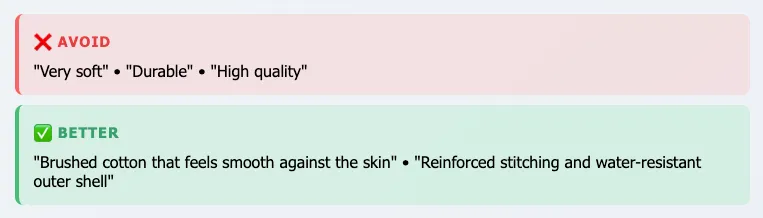
The more clearly you describe the product’s real value, the easier it is for someone to say “yes, that’s exactly what I need.”
2. Copy default text or repeat product titles
One of the most common shortcuts is copying the product title into the description field, or using placeholder text like “This is a great product.” It fills the space, but it doesn’t help the customer.
Shopify already displays the product name clearly. Your description should go further by answering questions, showing benefits, or offering helpful context.
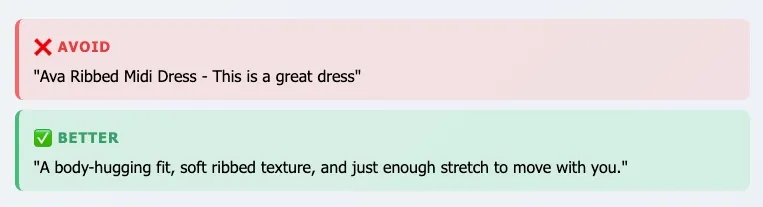
So, instead of repeating “Ava Ribbed Midi Dress” again in the first line, try: “A body-hugging fit, soft ribbed texture, and just enough stretch to move with you.”
That’s more useful and more persuasive.
3. Write for bots instead of people
Trying to rank on Google is important, but writing solely for search engine results in stiff, awkward copy that customers tune out.
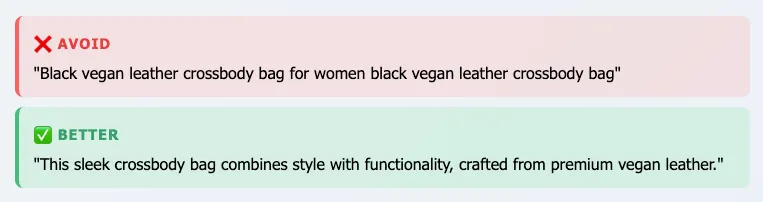
Stuffing your description with repetitive keywords like “black vegan leather crossbody bag for women” over and over won’t help. It’s harder to read, and it can hurt your credibility.
Instead, aim for natural, helpful language. You can use keywords where they make sense, but focus on clarity and flow first. If your product solves a problem, say how. If it has a standout detail, lead with that.
Search engines are becoming increasingly adept at identifying high-quality content. Your customers already expect it.
4. Use unverified claims or superlatives without proof
Saying your product is “the best,” “#1 on the market,” or “life-changing” can backfire if there’s nothing to back it up. Buyers today are skeptical. They don’t just want to be told something is great, they want to see why.
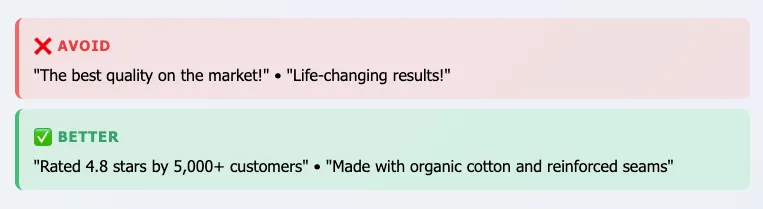
If your product is high quality, explain what makes it so:
- Mention the materials, the craftsmanship, or the testing process.
- Add a real quote from a customer or reviewer.
- Use social proof like “Trusted by 10,000+ customers” or “Rated 4.8 stars.”
The goal is to build credibility with specifics.
5. Ignore consistency in tone and brand voice
Even if your product copy is clear and well-written, it can still fall flat if the tone doesn’t match the rest of your store.
Your product descriptions are part of your brand experience. If one product sounds playful and another sounds overly technical or generic, it creates friction and makes your store feel disconnected.
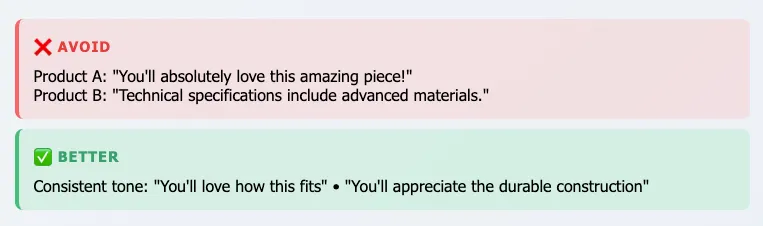
Whether you write everything yourself or use AI tools, aim for consistency:
- Stick to the same point of view (e.g., second person: “you’ll love…”)
- Use similar sentence length and formatting across products
- Match the tone to your audience, such as casual, elevated, bold, calm; just stay consistent.
Consistency builds trust. It helps shoppers move from one product to another without feeling like they’ve landed on a different website.
FAQs About Shopify Product Descriptions
How do I write a product description on Shopify?
You can write or edit product descriptions directly in your Shopify admin. Just go to Products → Click on a product → Edit the description field. For better results, start with a strong opening sentence, focus on benefits, and ensure it is easy to scan, especially on mobile devices.
How long should a Shopify product description be?
You should aim for 3-5 short paragraphs or a mix of sentences and bullet points, enough to answer the buyer’s top questions without overwhelming them. Length can vary by product type, but clarity and structure matter more than word count.
How do I change my Shopify product description?
In your Shopify admin, go to Products → Choose the product → Scroll to the description box → Edit → Save. You can also edit in bulk using Shopify’s bulk editor or with product CSV exports if you manage a large catalog.
Can I use AI to write product descriptions on Shopify?
Yes. Shopify Magic can help you generate product descriptions based on your keywords and tone. You can also explore other Shopify product description generator AI tools like ChatGPT or Jasper, especially if you want more control than the built-in Shopify description generator.
How do I format descriptions with HTML or blocks?
In the Shopify description editor, you can use basic formatting tools (bold, bullets, links) or click “Show HTML” to manually add formatting. For advanced layouts, such as tabs, videos, or styled sections, you can use metafields or customize your theme’s product template. If you’re editing your theme directly, the product.description Shopify Liquid object controls where the content is rendered on the page.
Are product descriptions important for Shopify SEO?
Yes. Well-written, keyword-optimized product descriptions enable search engines to understand your content, ultimately improving your page rankings. Focus on natural language, include relevant keywords, and avoid duplicate descriptions across products. Add structured data (like price and availability) if your theme supports it.
Key Takeaways
A great Shopify product description does more than describe, it converts. To write descriptions that actually move the needle, you should:
- Focus on benefits, not just features
- Write for your customer, not for search engines
- Use structure and language that’s easy to scan
- Avoid vague claims, generic phrases, and inconsistent tone
- Use AI and templates to move faster, but always refine for your brand
At LitOS, we help ambitious brands grow smarter on Shopify – with better tech, sharper strategy, and hands-on support that actually drives results. From migration to growth, we make the process seamless and built to scale.
Have something in mind? Contact us now →

